
 EARS
 NOSE
 THROAT
 DIZZINESS
 TINNITUS
 SEARCH


How is Hearing Loss Measured?
AIR CONDUCTION
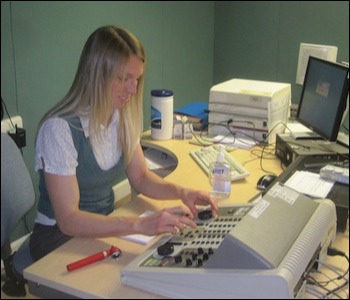
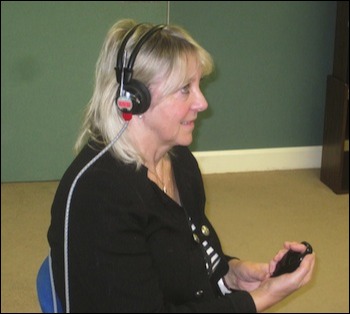
Hearing loss is measured using a machine called an Audiometer. The machine produces sounds of different frequencies at differing volumes. The sounds it produces are called Pure Tones. Anything between 4 to 8 different frequencies will be measured per ear. The test should be done in very quiet surroundings, preferably a sound proofed room. The patient wears ear phones and holds a device with a button. One ear is tested at a time. A sound is presented through the ear phone. If the patient can hear it he will press the button. The Audiologist will reduce the volume of the sound and present the sound again. This process is repeated until the patient no longer hears the sound. By increasing and decreasing the volume the quietest sound which the patient can hear is determined. This volume is recorded on a graph called an audiogram. The process is repeated for a number of different frequencies and then the other ear is tested. This is a test for AIR CONDUCTION(AC).
Air Conduction (AC) is a test of how well you can hear sounds. The sounds you are hearing start off travelling through the air then down the ear canal then through the middle ear then into the inner ear. If the hearing is reduced we can not tell if the problem is in the middle ear or the inner ear – it could be either or both. We need to be able to measure the function of just the middle ear or just the inner ear and compare it to the AC levels to work out what part of the hearing pathway is at fault. We do this by measuring the inner ear function.
BONE CONDUCTION

Bone conduction is a way of measuring inner ear function. The process is similar to above except a small vibrator is held tightly against the bone behind the ear. The vibrator is made to vibrate at different volumes. The vibrations make the bone of the skull vibrate. The inner ear is part of the bone of the skull so it vibrates as well causing the fluid inside it to vibrate. So just as the hearing bones cause the fluid in the inner ear to vibrate so we hear sound the bone conductor causes the fluids to vibrate and we hear the sound of the bone conduction vibrator.


TYPES OF HEARING LOSS
By knowing the Air Conduction levels and the Bone Conduction levels we can work out what part of the hearing system is not working. This allows us to classify hearing losses as :
SENSORINEURAL
CONDUCTIVE
MIXED (some sensorineural hearing loss and some conductive loss)
Read more about the types of hearing loss…
The Audiogram

The Audiogram is the graph on which we plot the results of the hearing test. Also known as the Pure Tone Audiogram.
On the Horizontal axis are the frequencies of the sound which are presented to the patient. The frequencies tested range from 125 Hertz(Hz) up to 8000 Hz.
125 Hz is a low tone sound. 8000 Hz is a high tone sound.
On the Vertical axis is the volume of the sound presented. The volume is measured in Decibels(dB). This is actually a measure of pressure – the pressure of the sound wave. The higher the pressure the louder the sound.
10 dB is very quiet and 120 dB is very loud – as loud as a chain saw.

The scale is exponential not linear. The loudness of a sound doubles for ever 10 dB increase in volume. In other words 40 dB is not twice as loud as 20 dB but 4 times as loud.
0 dB is not silence but quietest sound a group of normal hearing people can hear. So some people with very good hearing – better than the average – may be able to hear sounds at -5 or -10 dB.
For each frequency of sound we plot the volume at which the patient can just hear the sound. This is called their HEARING THRESHOLD.
How deaf am I?
By looking at the Hearing Threshold we can classify the degree of hearing loss.

Less than 25dB the hearing is NORMAL.
25-40 dB is a MILD hearing loss
40 – 65dB is a MODERATE hearing loss
65 – 90dB is a MODERATELY SEVERE hearing loss
70-90dB is a SEVERE hearing loss
> 90dB is a PROFOUND hearing loss.
What do these classifications mean?
MILD Hearing Loss
– most people will get by day to day – especially by employing various strategies such as turning the volume up, asking people to repeat themselves, watching peoples faces, avoiding noisy backgrounds. Everyone has different lifestyles and some people can employ these strategies more easily than others. Those who can not find this level of hearing loss very irritating.
MODERATE Hearing Loss
– these people will often have great difficulty hearing in background noise. Even in the quiet they will have to concentrate hard to hear and this can become very tiring.
SEVERE Hearing Loss
– These people will not really be able to communicate without some form of amplification such as a hearing aid.
PROFOUND Hearing Loss
– For these patients the hearing is too bad even for a hearing aid. Some people are amazing lip readers, others communicate by sign language or writing things down and some patients will benefit from a cochlear implant.
Having said all the above it is difficult to predict the exact effect of a hearing loss on a patients life just by looking at the audiogram. The same audiogram could affect two different people in very different ways.
…but do I need a hearing aid?
People ask do they need a hearing aid based on what the audiogram shows. It is possible to say whether or not a hearing aid may help but you can not really say that someone ‘needs’ a hearing aid because ultimately that is their choice.
If someone does not feel that they have a problem – whatever the Audiogram shows – they are very unlikely to use a hearing aid.
A Hearing Aid is an ‘AID’ – a device to the help a patient solve a problem that they are having with hearing.
The most important first step in getting help with a hearing problem is to ACCEPT that you have a problem and it can take some people many years to do this.