
 EARS
 NOSE
 THROAT
 DIZZINESS
 TINNITUS
 SEARCH


There are many possible causes of deafness and some people may have more than one cause at the same time.
Causes of a CONDUCTIVE hearing loss
EAR CANAL
No ear canal – some children are born without an ear canal
Foreign body – a cotton bud, a bead, a sweet – anything put into the ear that blocks the canal will cause a conductive deafness
Wax – if wax completely blocks the ear canal it will cause deafness
Exostoses – bony swelling of the walls of the ear canal making it very narrow so that it blocks ver eaily with wax or infection
Otitis externa – infection of the ear canal skin causes it to swell and if the swelling bloks the ear canal it will cause deafness. Usually temporary – hearing returns as the infection settles.
Meatal stenosis – the ear canal becomes blocked with scar tissue.
Tumour – a cancer of the ear canal lining is very rare.
EAR DRUM
Perforation – a ‘Tympanic Membrane Perforation’ is themedical term for a hole in the ear drum.
Scarring of the ear drum – the ear drum can become very stiff so that it does not vibrate efficiently so the sound is not transmitted well.
MIDDLE EAR
The middle ear should be a space filled with air which allows the ear drum to vibrate properly. Anything in the middle ear space may stop the ear drum from vibrating effectively or the hearing bone from moving properly.
Different things can fill the middle ear space:
Glue ear – Middle ear filled with thick mucus.
Secretory otitis media – Middle ear filled with fluid
Acute otitis media (middle ear infection) – Middle ear filled with pus
Cholesteatoma – skin in the middle ear
Tumour – benign or malignant tumours in the middle ear are rare
HEARING BONES
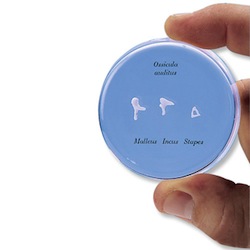
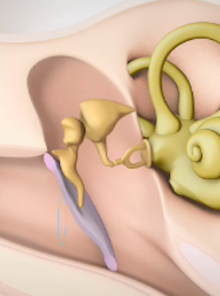
There are 3 hearing bones in a row.
The Malleus bone attaches to the ear drum and the Incus bone. The Incus bone attaches to the Malleus bone and the Stapes bone. The Stapes bone attaches to the Incus bone and the inner ear.
Sound is transmitted through these bone from the ear drum to the inner ear.
If there is a gap between the bones or the joints between the bones are abnormal the sound will not pass through properly.

Dislocation – A bang to the head can cause the bones to come apart
Erosion – some conditions such as a retraction pocket or a cholesteatoma can wear the bone away – usually the incus bone
Fracture – It is rare for the bones to actually break but it can happen
Congential abnormality – Some people may be born with abnormal hearing bones.
If the bones become STIFF then they do not vibrate freely and the sound vibrations are damped down.
OTOSCLEROSIS – this is where the stapes bone becomes stiff or ‘fixed’. The stapes bone fills a small opening into the inner ear. The bone is held in place in the opening by an elastic ring which joins the edge of the stapes bone to the inner ear and allows it to vibrate freely. In otosclerosis this elastic ring turns to bone and the stapes bone can not move freely which reduced the transmission of the sound waves so less energy enters the middle ear.
Causes of a SENSORI-NEURAL hearing loss
Sensori-neural hearing loss can be CONGENITAL or ACQUIRED
Congenital = born with deafness
Acquired = develop deafness after birth
ACQUIRED DEAFNESS can be sudden or progressive
Sudden = hearing loss comes on very quirky – usually within a period of 3 days. Sometimes people may wake up with deafness
Progressive = comes on over weeks, months or years.
Genetic – an abnormality of the genes for hearing means that the hearing system does not develop properly. Can be SYNDROMAL = associated with abnormalities of other parts of the body or NON- SYNDROMAL = only affects the hearing system
Infection – can be viral of bacterial. Meningitis is frequently associated with hearing loss. Also mumps or measles.
Drugs – some drugs will damage the inner ear causing deafness. Some antibiotics, some diuretics and some anti cancer drugs.
Noise – prolonged noise exposure can damage the inner ear causing deafness.
Trauma – a head injury can damage the inner ear. A skull fracture could damage the inner ear or the hearing nerve. Sudden pressure changes can damage the inner ears. this can happen in divers and is clued barotrauma.
Age – probably the commonest cause of sensori-neural hearing loss. Known as PRESBYACUSIS. 75% of over 75 yr olds will have a hearing loss. Usually affects the higher frequencies more than the lower frequencies.
Tumour – a benign tumour called an acoustic neuroma can press on the hearing nerve and cause hearing loss. Isualy one sided.
Menieres Disease – A disease where the patient experiences sudden onsets of dizziness, tinnitus, fluctuating hearing loss and blocked feeling in the ear. the eating loss usually returns after an attack but over time the hearing gets worse.